Walk any established plant and you will find machines older than the engineers running them - reliable, paid-off, and completely un-connected. The assumption is that predictive maintenance is only for new, sensor-rich equipment. It is not. Most legacy machines already produce enough data to become predictive; the work is retrofitting, not replacing.
This post answers a scoped question: how do you add predictive analytics to old production equipment without a costly rip-and-replace?
Why legacy machines are better candidates than they look
Old does not mean dumb. A machine with a variable-frequency drive, a PLC, or even a motor control center is already generating signals that track its health. And because legacy assets have run for years, they come with something new equipment lacks: a long history of how they behave - and how they fail.
Where the data already is
Before you buy a single sensor, map what you already have.
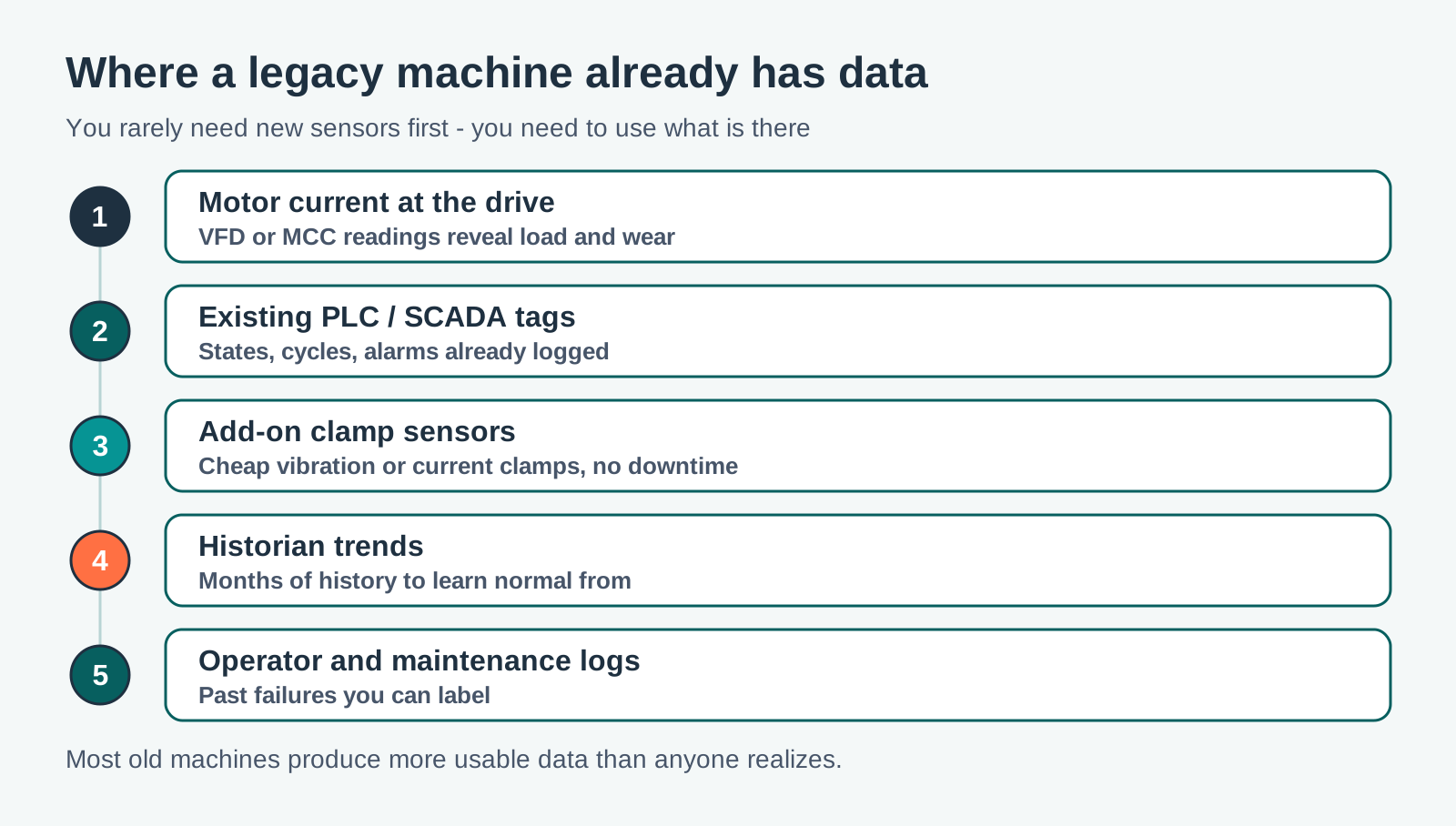
- Motor current at the drive or MCC rises and changes shape as mechanical load and wear increase.
- Existing PLC/SCADA tags - cycle times, states, alarms - are often already logged.
- Historian trends give you months of normal behavior to learn from.
- Maintenance and operator logs are a record of past failures you can label.
Cheap ways to fill the gaps
Where a signal is genuinely missing, you rarely need a full automation project. Clamp-on current sensors, wireless vibration or temperature pucks, and a small edge gateway can add the missing channel in an afternoon, with no downtime and no PLC changes.

The real work is labeling the history
Retrofitting hardware is the easy 20%. The value comes from labeling: going back through the historian and the maintenance log to mark past failures, so a model can learn their signature. That labeled history is what turns raw retrofit data into a working prediction. (See our post on data labeling.)
Use case in practice: a 20-year-old homogenizer at a dairy
A dairy runs a homogenizer installed in the early 2000s. No smart sensors, but it has a VFD driving the main motor and a PLC logging cycles.
- Existing data: motor current from the VFD, plus PLC run/stop states, pulled through a small edge gateway.
- Cheap add-on: one clamp-on vibration sensor on the pump head.
- Labeling: three years of maintenance records mark two seal failures and one bearing failure - each tagged on the current and vibration history.
- Result: the model learns the rising-current-and-vibration signature that preceded each failure and now warns days ahead - on a machine everyone assumed was "too old for that."
Practical rule
Do not let the age of a machine decide whether it can be predictive. Ask instead: what does it already measure, what history can I label, and what one cheap sensor closes the gap? Start with the asset that hurts most when it stops.
Retrofit starts with the data you already have. Pull one legacy machine's signals, label its past failures, and build a prediction in Predsense labeling: https://www.predsense.ai/products/labeling