Most industrial AI projects do not die in the lab. They die in the budget meeting. A working model is not enough - leadership funds outcomes, not algorithms. A business case is what translates a technical idea into the language executives act on: money, payback, and risk.
This post answers a scoped question: how do you turn an AI idea into a business case that a plant manager or CFO will actually approve?
Start from the cost of the problem, not the promise of AI
The strongest business case does not begin with "AI can do X." It begins with "this problem costs us Y per year." Before you model a benefit, size the pain: unplanned downtime hours x fully loaded cost, scrap value, energy waste, warranty claims, missed throughput. If you cannot put a number on the problem, you cannot credibly put a number on the fix - and the case will stall.
The anatomy of an AI business case
Every credible case quantifies three things:
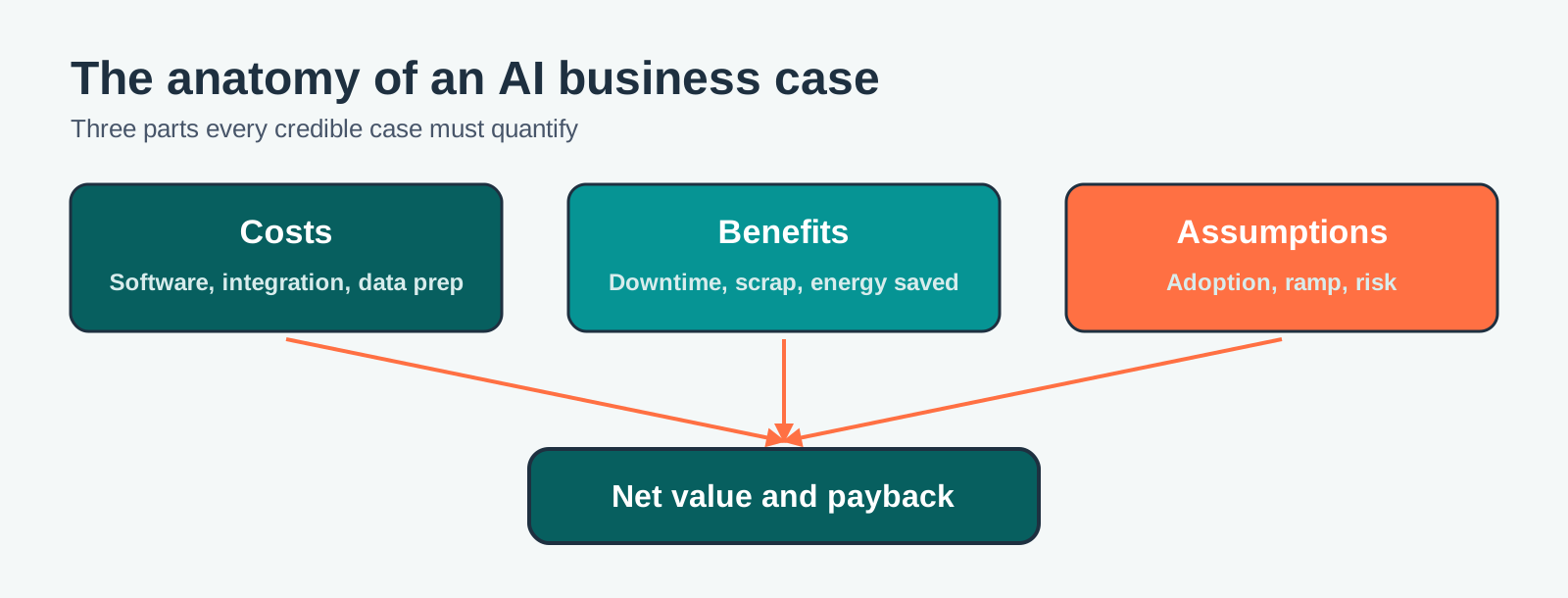
1) Costs (total cost of ownership). Software and licenses, integration, data preparation and labeling, compute, internal time, and change management. Data prep is usually the biggest and most underestimated line. 2) Benefits. Downtime avoided, scrap reduced, energy saved, throughput gained, labor redeployed - each tied to the baseline you measured. 3) Assumptions and risk. Adoption rate, ramp time, expected model performance, and data readiness. State them openly; hidden assumptions are what sink a case under scrutiny.
Build the benefit model conservatively
The fastest way to lose credibility is an optimistic number. Model on one line or asset, and assume you capture a *share* of the problem, not all of it. If a failure type costs 480,000 EUR/year, do not claim you will eliminate it - claim you prevent, say, 40%. Show a low / expected / high range so reviewers see you have thought about uncertainty. A defensible 192,000 EUR beats an unbelievable 480,000 EUR.
Do not forget the unglamorous costs
Two costs get skipped and then blow up the case later:
- Data preparation and labeling - turning raw signals into a usable, labeled dataset is real effort and often the critical path.
- Ongoing costs - monitoring, retraining, and support after go-live. A pilot number that ignores year-two costs is not a business case.
Payback, ROI, and how to present them
Give reviewers the three numbers they expect:
- Payback period = months to recover the investment.
- ROI = (annual benefit - annual cost) / total cost.
- For multi-year programs, NPV discounts future benefits to today.
Use case in practice: a beverage bottling line
Make it concrete with the filler-capper on a PET bottling line at a beverage plant:
- Problem cost: 120 downtime hours/year x 4,000 EUR = 480,000 EUR/year in lost production and wasted product.
- Conservative benefit: prevent 40% -> 192,000 EUR/year.
- Costs: 60,000 EUR pilot + 40,000 EUR/year run cost.
- Year one: 192,000 - (60,000 + 40,000) = 92,000 EUR net.
- Payback: ~6 months. ROI (year one): ~92%.
Notice the numbers are modest and defensible. That is the point.
How you would build it: pull the line's existing PLC/SCADA signals (motor current, torque, capper pressure, line speed), attach context (SKU, bottle format, shift), and label the last year of filler jams and capper failures. That labeled history is what turns the 40% assumption into a real model - and it is the line item the business case is actually funding.
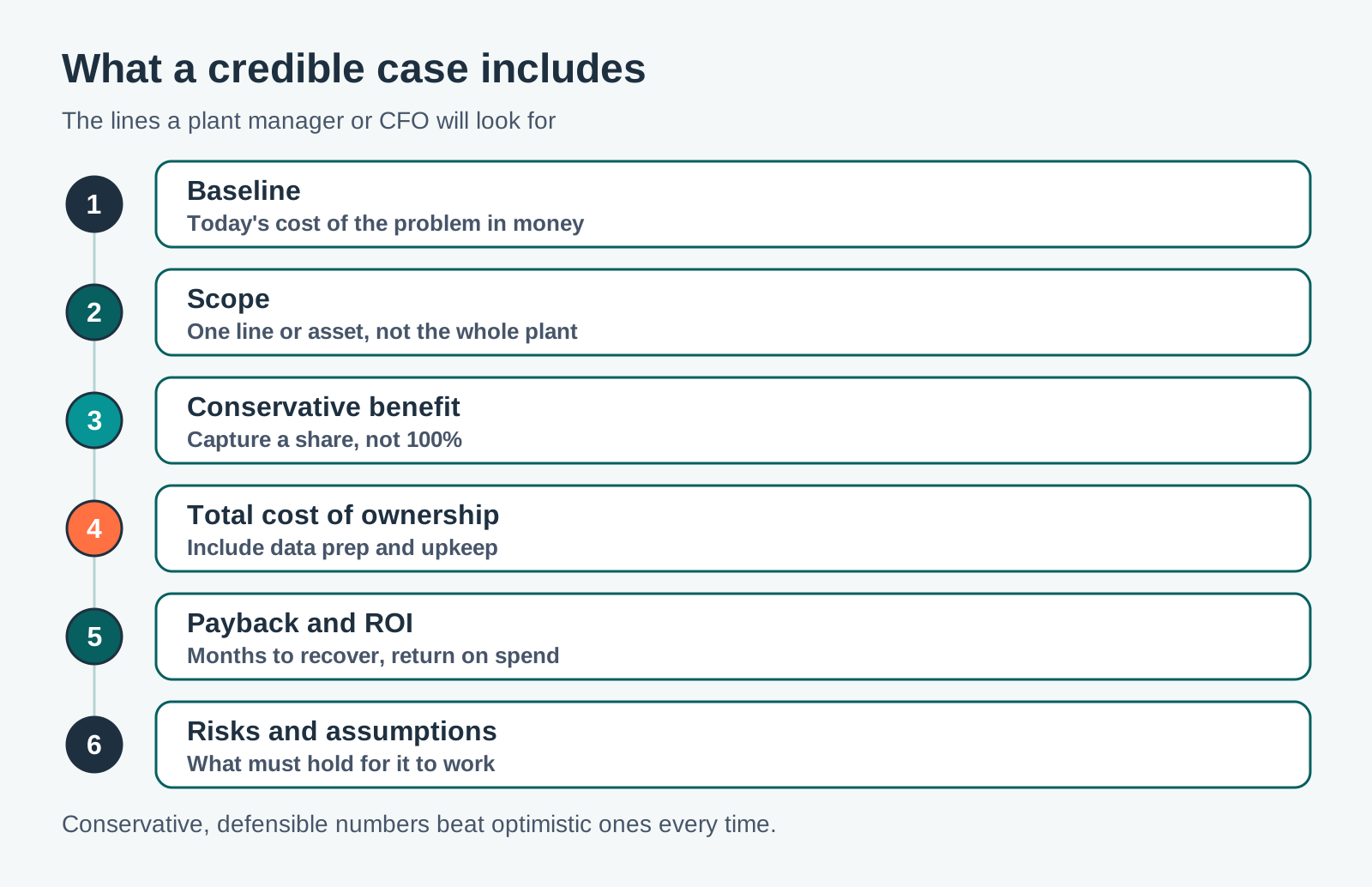
What a credible case includes
De-risk it with a phased plan
Do not ask for a plant-wide budget on day one. Structure it as pilot -> prove -> scale, and tie spend to milestones. Name the owner, the success metric, and what happens if the model is wrong (false-alarm cost, human-in-the-loop review). A phased case is easier to approve because each stage is small and self-justifying.
Practical rule
A business case for industrial AI is not a technology pitch. It is a money argument: here is what the problem costs, here is the conservative share we can recover, here is what it costs to do, and here is when it pays back. Win the first one small, prove the number, and the second case funds itself.
The line item that decides feasibility is data. Before you promise a benefit, make one dataset ready - import your signals, add context to events, and label the outcomes you want to predict in Predsense labeling: https://www.predsense.ai/products/labeling