Every plant now has a list of AI ideas - predict this failure, optimize that energy, inspect this defect. The list is never the problem. The problem is that budget and engineering time fund maybe two of them this year, and the wrong two can burn a year with nothing to show. Prioritization by business impact - not by whoever spoke loudest - is what separates an AI program that compounds from one that stalls.
This post answers a scoped question: once you have a list of candidate AI projects, how do you rank them by business impact and decide what to build first?
(If you do not yet have candidates, start with our post on identifying AI use cases; this post is about ranking the list you already have.)
What "business impact" really means
Impact is not only direct cost savings. Score each project across the value it actually creates:
- Money - downtime avoided, scrap reduced, energy saved, throughput gained, annualized.
- Quality and compliance - fewer defects, fewer deviations, audit and regulatory risk reduced.
- Safety - incidents avoided (often a veto-level factor on its own).
- Strategic value - does a win scale to other lines and build capability, or is it a dead end?
Put a number on the money wherever you can, and a 1-5 score on the rest. A project with modest savings but high strategic or safety value can still outrank a bigger number.
Why a two-axis screen is not enough
A quick value-vs-feasibility 2x2 is great for a first filter. But to rank a portfolio you need more than two dimensions, and you need to weight them. A weighted scorecard makes the trade-offs explicit and the ranking defensible.
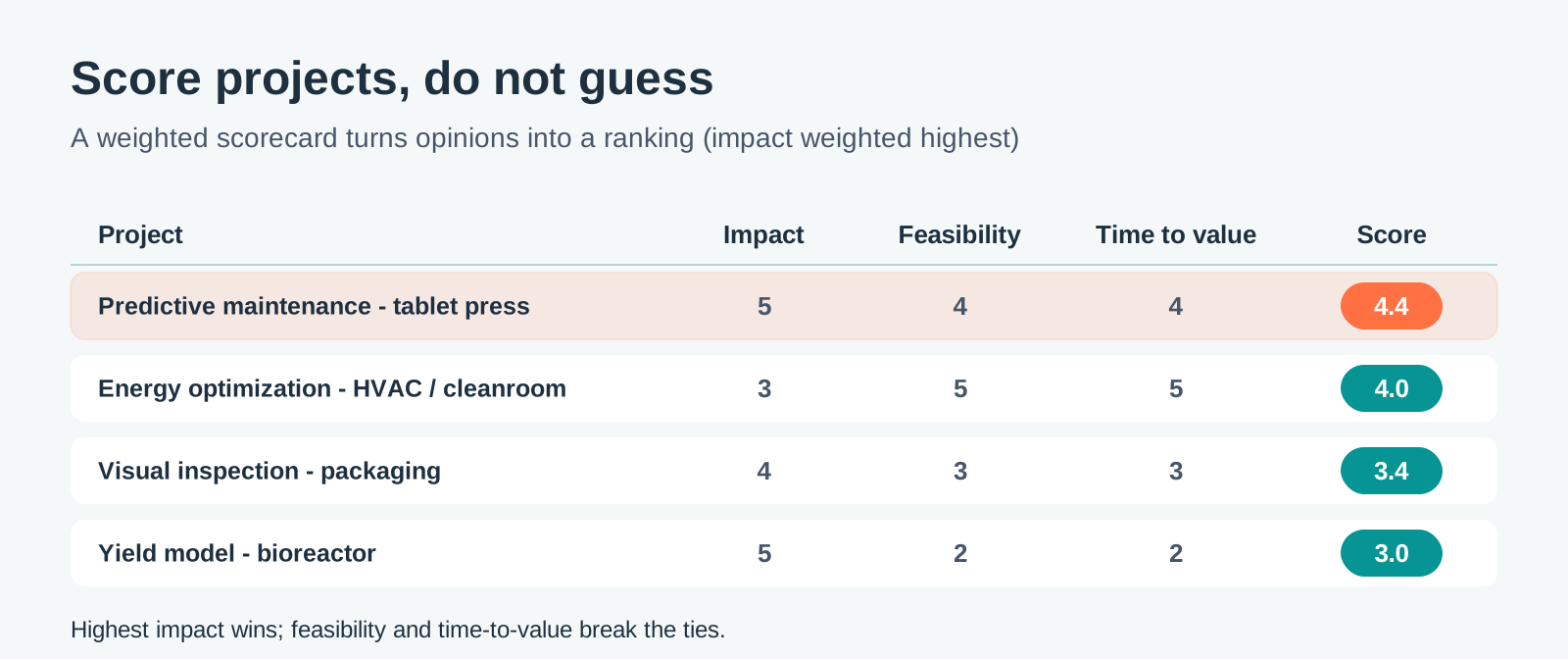
Score each candidate on:
- Business impact (weighted highest) - the value above.
- Feasibility / data readiness - do the signals exist, sampled often enough, with context, and can outcomes be labeled? This is usually the real constraint.
- Time to value - weeks to a provable result, or quarters?
- Strategic fit / scalability - does it build reusable capability?
Weight them (impact heaviest), score 1-5, and let the total rank the list. The point is not false precision - it is a transparent, shared basis for the decision.
Feasibility is mostly a data question
Two projects can have identical impact; the one whose outcomes you can label is the one you can actually build this quarter. That is why data readiness dominates feasibility - and why "high impact, data not ready" projects belong in a prepare-the-data track, not on the shelf. (See our post on why factory data needs context.)
Rank, then sequence
The ranking gives you an order; a roadmap gives you a plan. Do not simply build the single top score and wait. Sequence the list:
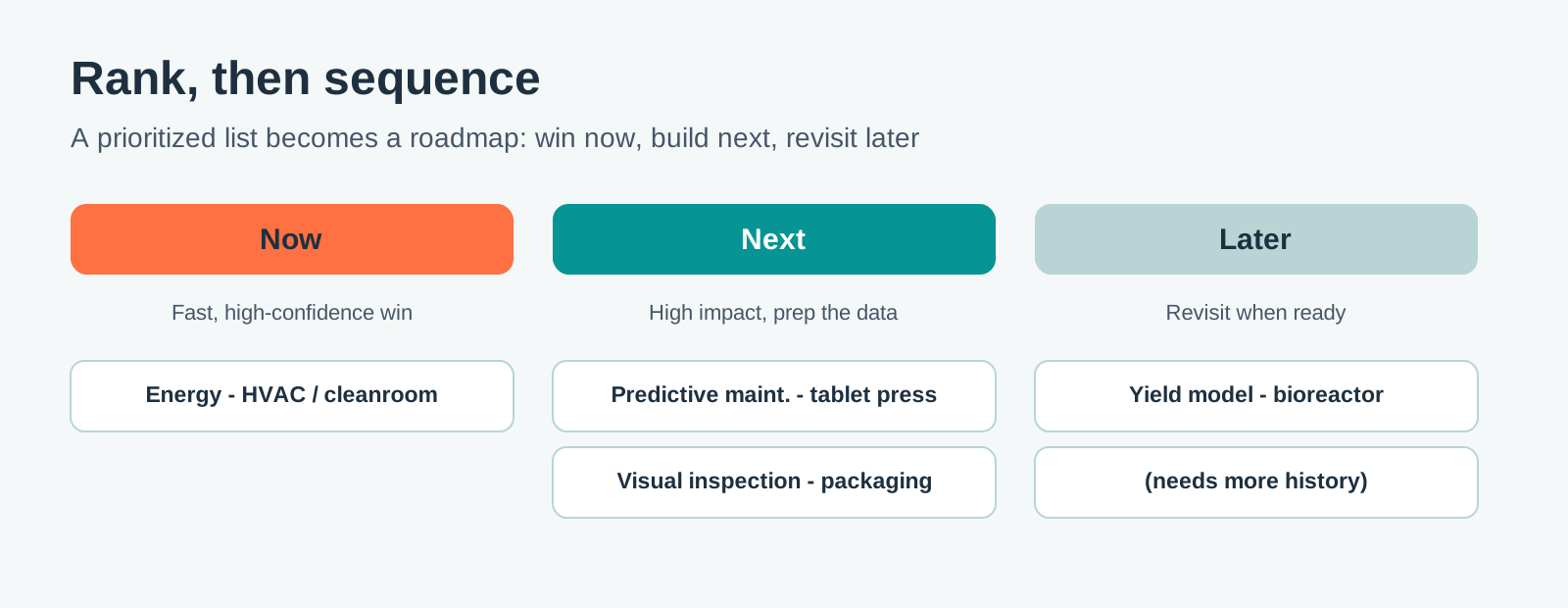
- Now - the fastest high-confidence win, even if it is not the biggest number. An early, visible result builds the trust that every later project depends on. (See our post on why adoption is about people.)
- Next - the high-impact projects whose data you prepare in parallel.
- Later - high-value ideas that simply lack history yet; revisit when they have it.
The pitfalls that wreck prioritization
- The shiny object. Chasing the most impressive-sounding AI instead of the most valuable.
- The HiPPO decision. "Highest paid person's opinion" overriding the score.
- Boiling the ocean. Ten pilots at once, none finished.
- Ignoring data readiness. Ranking on ambition and stalling on missing labels.
- Scoring once. Priorities shift; re-score as data and results come in.
Use case in practice: ranking a pharma site's AI portfolio
A pharma plant has four candidates on the table:
- Predictive maintenance on a tablet press - impact 5 (line-stopping failures), feasibility 4 (signals exist, failures partly logged), time-to-value 4. Score 4.4.
- Energy optimization on HVAC / cleanroom - impact 3, feasibility 5 (clean meter and load data), time-to-value 5. Score 4.0.
- Visual inspection on packaging - impact 4, feasibility 3, time-to-value 3. Score 3.4.
- Yield model on a bioreactor - impact 5, but feasibility 2 (only weeks of history). Score 3.0.
The ranking is clear, but the sequence is smarter than "just do #1": start with energy - it is fast and proves the approach to skeptics - while labeling the tablet-press failure history in parallel so the highest-impact project is ready next. The bioreactor waits until it has enough labeled batches. You are sequencing by impact *and* readiness, not by ambition alone.
Practical rule
Prioritizing AI is not a technical decision; it is a business one. Score impact honestly, weight it above everything, let data readiness decide what is buildable now, and sequence for an early win. A transparent scorecard beats the loudest voice in the room every time.
Every top-ranked project still needs labeled data to be real. Once you have picked the winner, make its data buildable - import the signals, add context, and label the outcomes in Predsense labeling: https://www.predsense.ai/products/labeling